The standard for metadata governance.
MQS is the metadata health score for digital asset libraries. Export your metadata, upload a CSV, and get a governance report in minutes. Free to start. No integrations required.
MQS does not measure completeness or accuracy. It measures governance.
Digital asset libraries, product catalogs, and content repositories grow faster than the governance around them. Inconsistent tags, templated descriptions, orphaned fields, and silent metadata drift accumulate over months and years. By the time someone notices, the cleanup is already expensive.
No structural baseline
You know your metadata is not perfect. But you do not have a number to quantify how far off it is, or a way to measure improvement over time.
Audits are manual and slow
Reviewing metadata quality field by field takes weeks. Most teams never finish. The ones that do cannot repeat it consistently next quarter.
Quality means something different everywhere
Every team has its own standard for "good metadata." Without a shared standard, governance conversations go in circles.
Data quality tools ask "are these values correct?" MQS asks "does this metadata show evidence of governance?" A perfectly accurate but ungoverned catalog will score poorly. A tightly governed catalog with gaps will score well. That is the point.
Traditional Data Quality Tools
- Measure accuracy, completeness, freshness
- Require system integrations and API access
- Score individual records or fields
- Flag wrong values
- Need ongoing configuration
MQS
- Measures structural governance and intentionality
- Runs on a single CSV, TSV, Excel, or OpenDocument export
- Scores your entire metadata structure
- Identifies governance patterns and drift
- Works immediately with zero setup
MQS runs entirely on your metadata export. No API connections, no system access, no vendor lock-in. Upload a file and get a structural assessment in minutes. Direct platform connectors are coming soon.
Export your metadata
Pull a CSV, TSV, Excel (.xlsx, .xls, .xlsb, .xlsm), or OpenDocument (.ods) export from your DAM, PIM, CMS, MAM, or any platform that stores structured metadata.
Upload to MQS
Drop your file in. MQS analyzes vocabulary patterns, format consistency, template usage, field uniqueness, and field-purpose alignment across your entire dataset.
Get your free report
Receive an overall score out of 100, broken down by dimension and signal. See exactly where governance is strong and where it needs attention.
MQS does not just measure. It tells you where your governance is strong, where it is breaking down, and what to prioritize. Every assessment produces a branded report with actionable recommendations.
Overall Score
A single metadata health score out of 100, weighted across both dimensions. Understand your governance posture at a glance, then drill into individual signals for specifics.
Branded Reports
Every assessment generates a structured, client-ready report with dimension breakdowns, signal analysis, AI-generated insights, and prioritized recommendations.
Platform Recommendations
Platform-specific guidance based on your DAM, PIM, or CMS. MQS knows the governance tools available in your system and recommends how to use them.
AI Readiness Assessment
A separate AI readiness overlay that tells you whether your metadata is ready for AI search, tagging, generation, and recommendations.
Team Portals
Shared dashboards for your team. Everyone sees the same reports, tracks the same clients, and works from the same governance baseline.
Filename Intelligence
Pattern analysis of your file naming conventions. Detects structured naming, camera defaults, delimiter usage, and segment classification.
Every report includes an overall score, signal breakdowns, AI-generated analysis, platform-specific recommendations, and an AI readiness assessment. Click or swipe to explore.
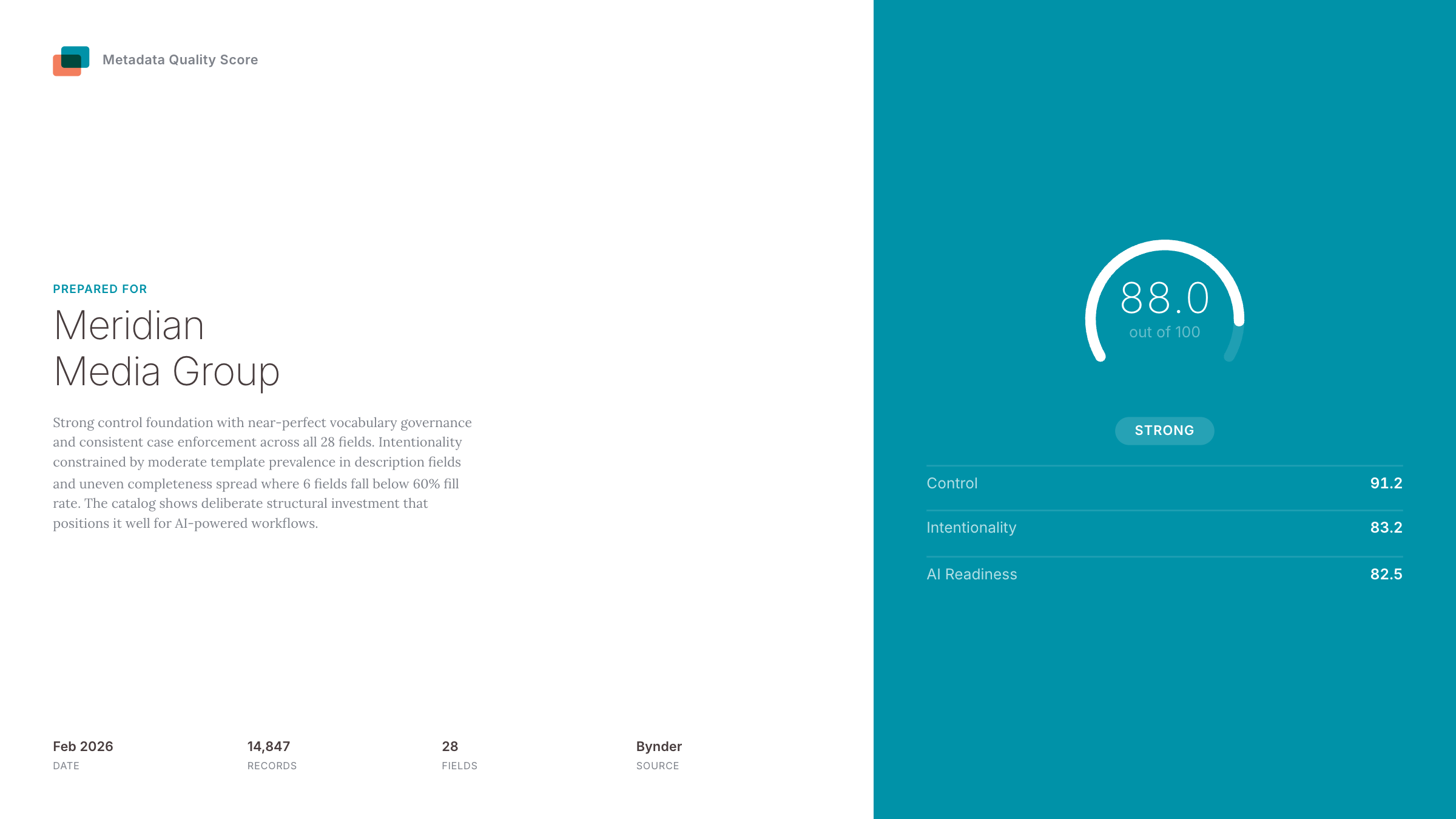
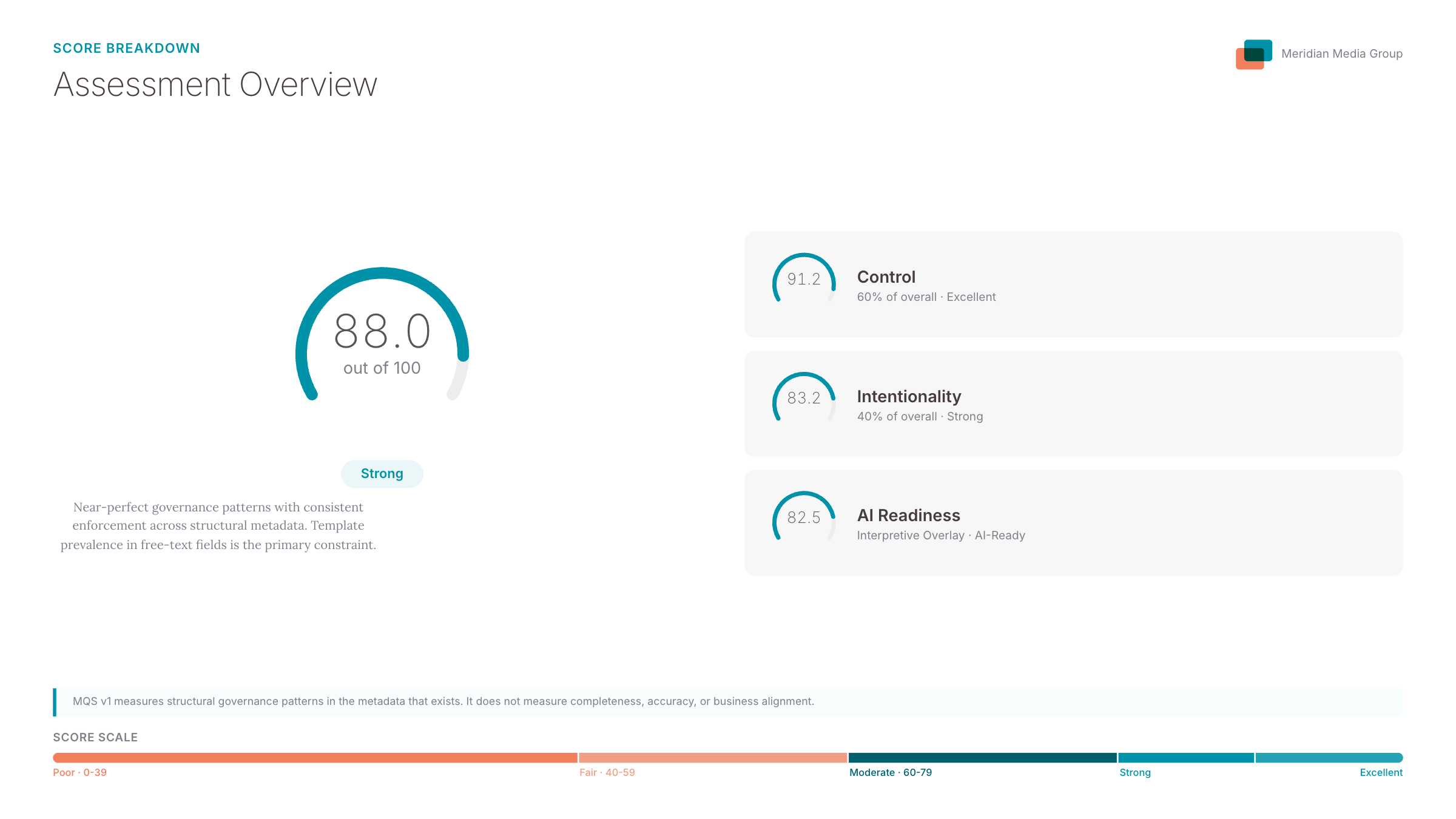
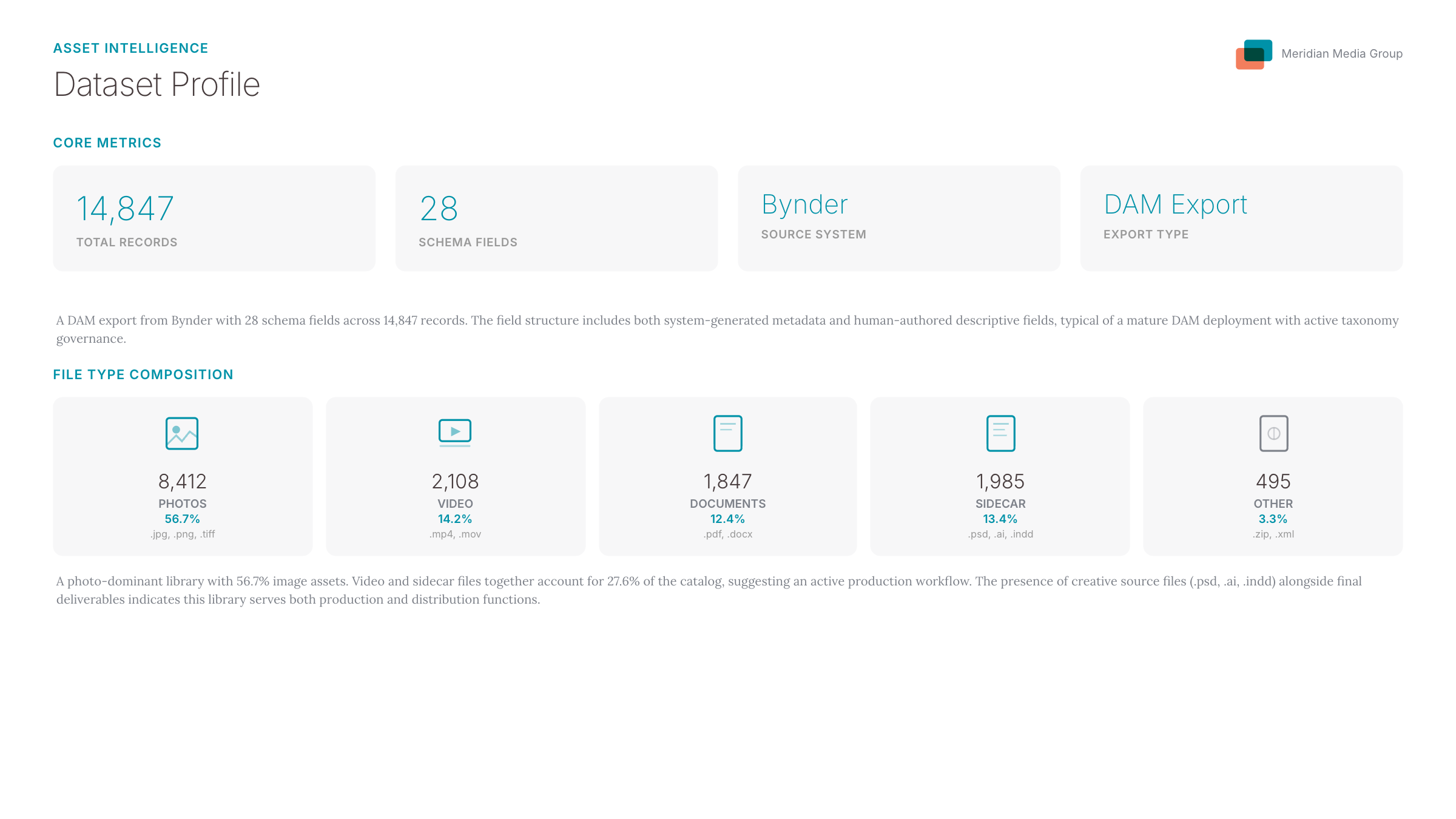
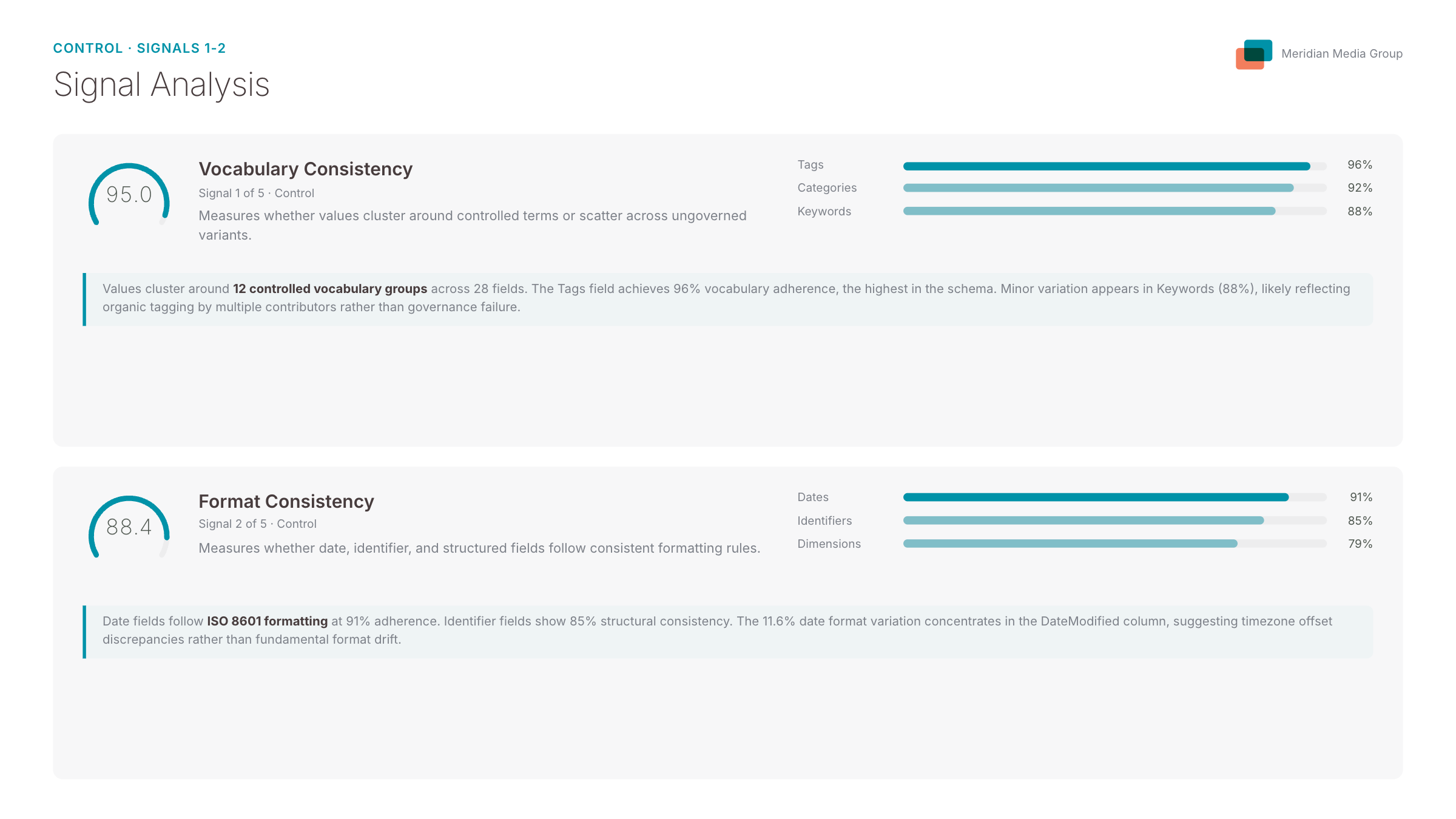
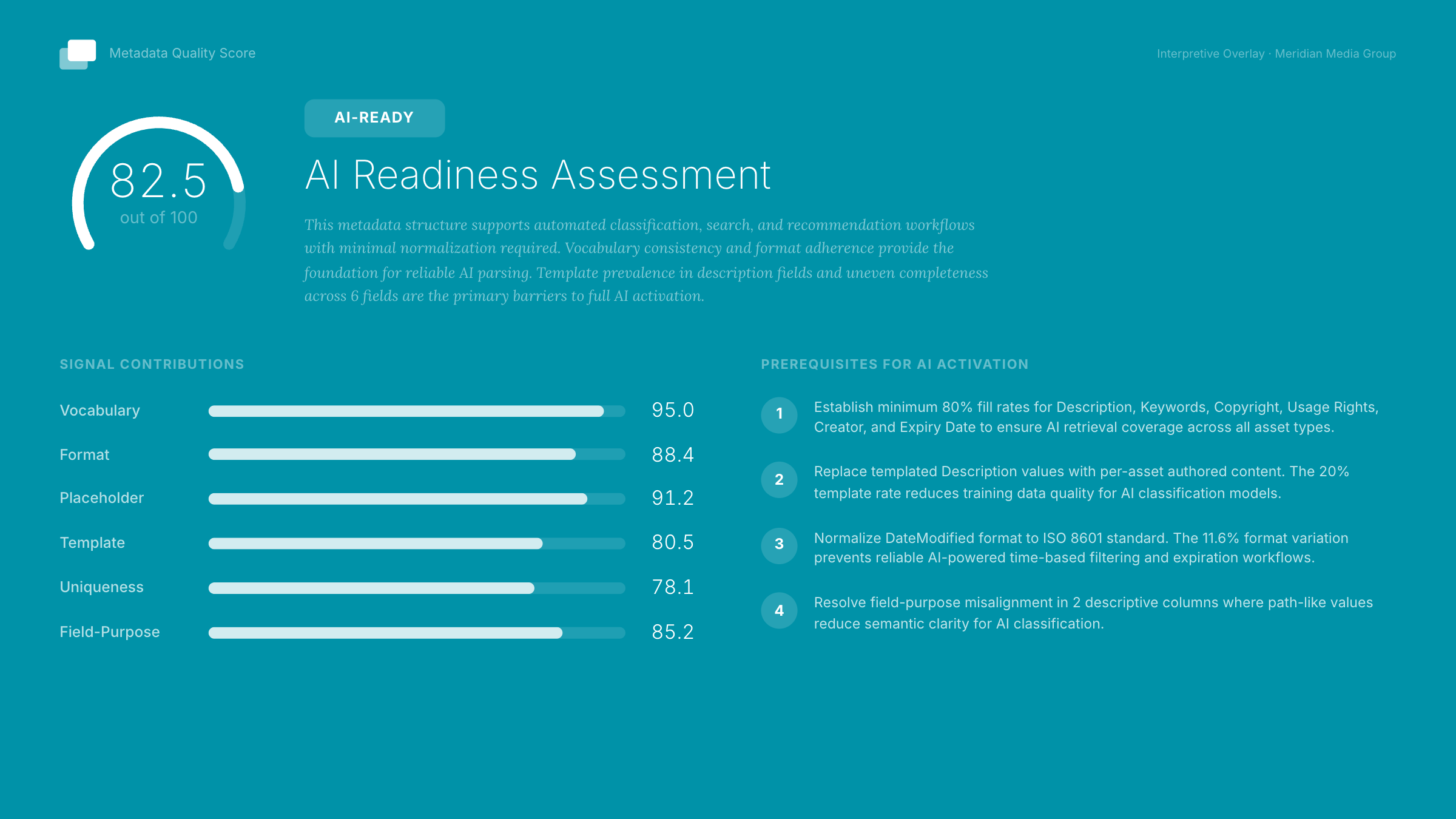
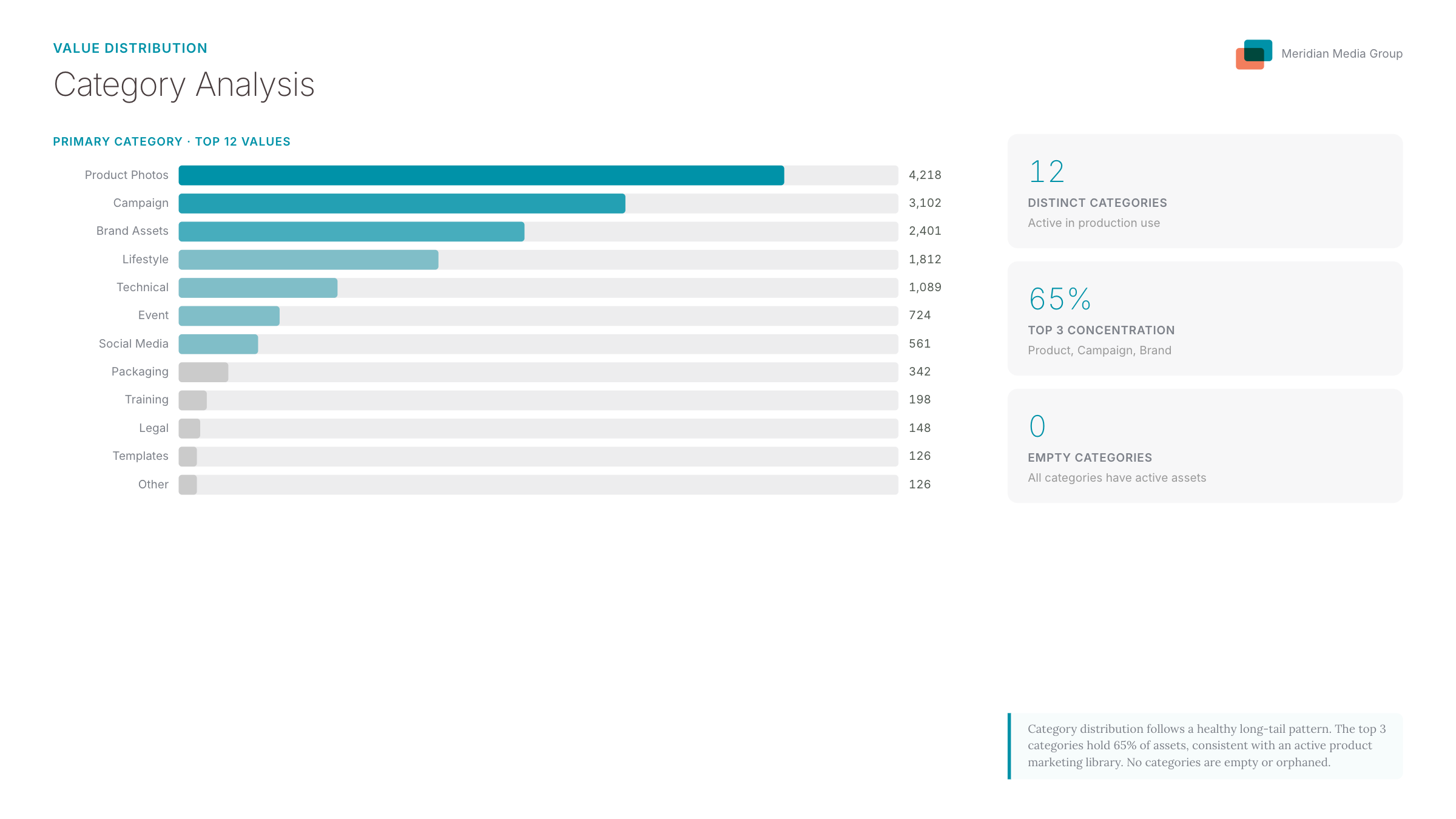
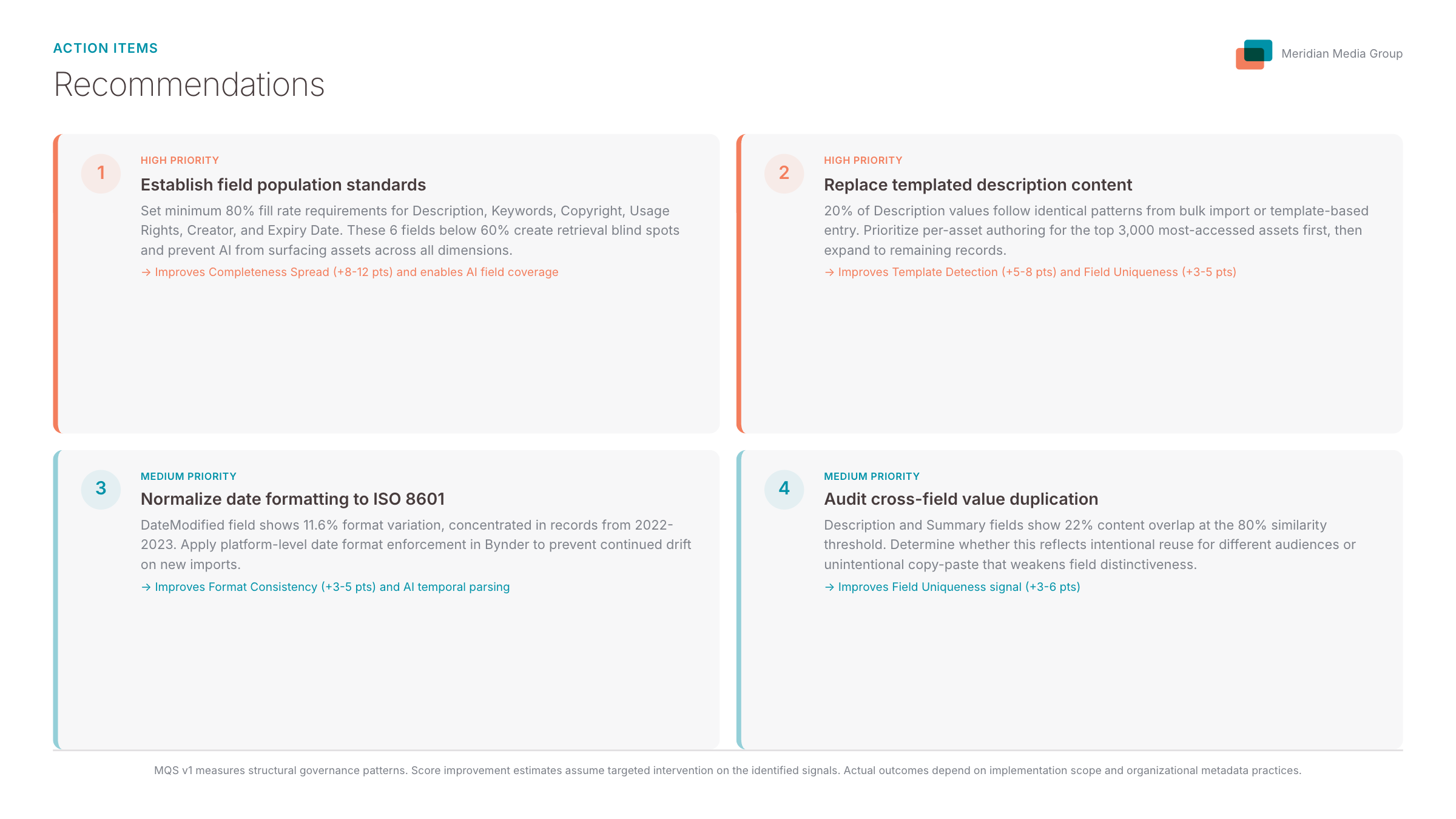
“MQS pulled out conclusions I already knew: duplications, vocabulary issues, and file name problems, all from a giant CSV. That is what built my confidence. It also surfaced patterns I would not have caught on my own. If it can do all that from a raw export, you can trust it with the full evaluation.”
MQS evaluates whether your metadata shows evidence of structural governance: controlled vocabularies, consistent formatting, intentional design, and purposeful field usage. It works with exports from DAMs, PIMs, CMS platforms, MAM systems, and any source with tabular metadata.
Control
Primary dimension
Measures whether metadata values conform to consistent, bounded patterns.
- Vocabulary Consistency
- Format Consistency
- Case Consistency
- Placeholder Detection
- Duplicate Absence
Intentionality
Secondary dimension
Measures whether metadata adds semantic value beyond mechanically derivable information.
- Template Detection
- Field Uniqueness
- Completeness Spread
- Field-Purpose Alignment
Every account includes a team workspace. Anyone who signs up with your company email is automatically connected to your organization. No invitations to manage. No permissions to configure.
Team Dashboard
Everyone on your team sees the same reports, tracks the same clients, and works from the same governance baseline. One place for your entire organization.
Client Collaboration
Share reports with external stakeholders via secure links. Attach a scored metadata report to a proposal, a budget request, or a project kickoff.
Progress Tracking
Run assessments before and after governance changes. Track score improvements over time and prove that your metadata investment is working.
MQS is not just a tool. It is a shared standard for metadata governance. Platforms integrate it. Consultants deliver it. Teams track it.
Platform Program
For DAM, PIM, and MAM vendors
Give your customers an independent metadata governance benchmark. Sales enablement, onboarding diagnostics, customer health monitoring. Trusted because it is not yours.
Learn more →Professional Services
For consultants and integrators
Turn the manual metadata assessment you already do into a scored, branded, repeatable deliverable. Discovery, migration scoping, progress tracking, governance retainers.
Learn more →Practitioner Program
Certified MQS practitioners
Earn the MQS Certified Practitioner credential. Access training, benchmark data, co-published case studies, and a directory listing with warm referrals.
Apply now →Every DAM, PIM, and CMS vendor is shipping AI features: search, tagging, generation, recommendations. These features run on your metadata. MQS tells you whether your metadata is ready for them.
Retrieval depends on vocabulary
AI search returns results based on your tags and categories. Inconsistent vocabulary means inconsistent retrieval.
Measures: Vocabulary Consistency
Training quality depends on descriptions
Auto-tagging models learn from your existing metadata. Templated or duplicated descriptions degrade training quality.
Measures: Template Detection + Field Uniqueness
Trust depends on structure
AI-generated metadata is only trusted when it follows established patterns. Inconsistent formatting and misaligned fields break that trust.
Measures: Format Consistency + Field-Purpose Alignment
"AI does not fix ungoverned metadata. It scales it."
Your metadata is uploaded to temporary encrypted storage, processed, and then automatically deleted. No raw file contents are kept or transmitted to third parties.
No Server-Side Storage
Your uploaded file is processed entirely in memory. Nothing is written to disk. Nothing persists beyond the analysis.
No Cross-Client Exposure
Every analysis runs in complete data separation. Your metadata is never mixed with another organization.
Zero Data Retention
When analysis completes, your source file is deleted from memory. MQS retains only the computed score and report.
No Third-Party Sharing
Your metadata is never transmitted to external services, analytics platforms, or training pipelines. Zero retention. Zero sharing.
MQS processes structure and patterns, not the content of your metadata values.
MQS is not a tool you run once and forget. It is a diagnostic you reach for at specific, high-stakes moments in the lifecycle of digital content.
Client & Vendor Discovery
Understand what you are inheriting. Run an assessment during onboarding to see the structural health of metadata before committing to timelines or budgets.
Migration Quoting
A source system scoring 44 is a fundamentally different migration than one scoring 82. See inside the data before you price the work.
Progress Reporting
You improved vocabulary governance, cleaned up templates, standardized formats. Show leadership: "We went from 42 to 71." Visible, measurable progress.
Post-Migration Health Check
Metadata is the most common casualty of platform migrations. Score the destination system and confirm that your data survived intact.
Agency Delivery Intake
An agency delivered 50,000 tagged assets. Before importing, score the metadata to verify it meets your governance standards.
Scheduled Governance Audit
Quarterly or annual assessments catch governance drift before it compounds. Think of it as an annual physical for your metadata schema.
Send us a message and we will get back to you within one business day.
Score your metadata today
Create a free account, upload a CSV export, and get your governance report in minutes.
Create Your AccountAlready have an account? Log in